


Your hair didn't get thinner.
It got starved.
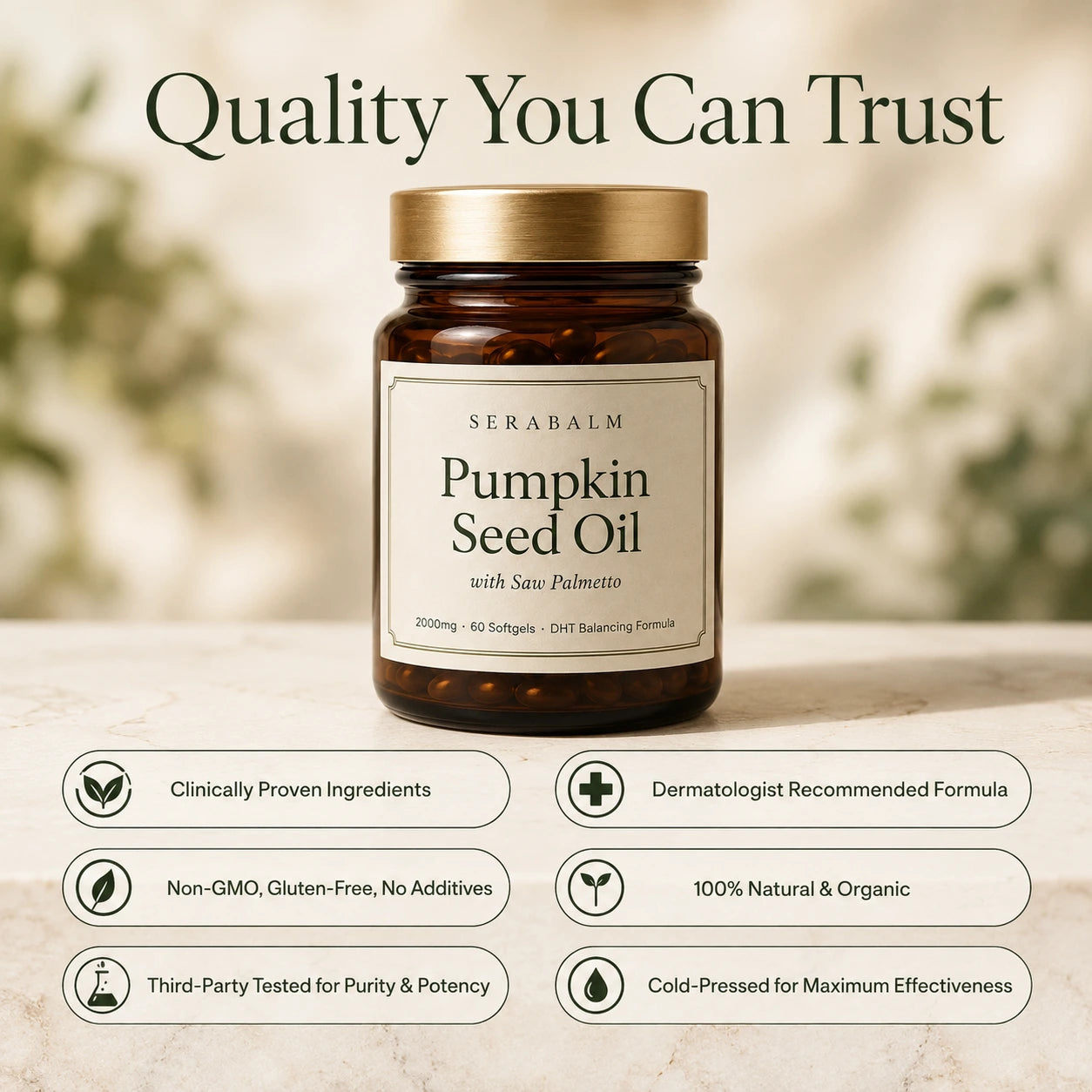
Most hair supplements target symptoms. But thinning hair in your 40s and 50s is driven by DHT — a hormone that shrinks your follicles from the inside. SeraBalm Root Formula gives follicles the one compound clinically shown to block DHT at the root, without a prescription.
Couldn't load pickup availability


Why does SeraBalm Root Formula work when nothing else has?
Why does SeraBalm Root Formula work when nothing else has?
Because it's not another supplement. It's not another biotin capsule or collagen powder or "hair growth blend" with seventeen ingredients and no clinical evidence behind any of them.
It addresses something none of those products touch: the hormone that
is actively shrinking your follicles right now.
DHT — dihydrotestosterone — is a byproduct of testosterone that binds to hair follicle receptors and slowly miniaturises them. The follicle produces a finer hair. Then a finer one. Then it stops producing altogether. This process is called follicular miniaturisation, and it is the primary driver of hair thinning in women over 40.
Most hair supplements are built around nutrients — biotin, keratin, collagen, zinc. These support the hair shaft. They do nothing to the follicle. They do nothing to DHT. You are feeding hair that is already growing while the follicles responsible for future growth continue to
shrink unchallenged.
SeraBalm Root Formula contains two compounds that work at the follicle
level, not the hair shaft level.
Cold-pressed pumpkin seed oil contains a group of phytosterols with a
molecular structure similar enough to DHT that they compete for the
same receptor sites on your follicles. When a phytosterol binds to the
receptor, DHT cannot. The follicle is protected. It keeps producing
hair. A randomised controlled trial published in Evidence-Based
Complementary and Alternative Medicine found a 40% increase in hair
count after 24 weeks of pumpkin seed oil supplementation.
Saw palmetto works upstream. It inhibits 5-alpha reductase — the enzyme that converts testosterone into DHT in the first place. Less DHT produced means less DHT available to bind to your follicles. Together, these two compounds address the problem at its source and at
its destination simultaneously.
This is why women who have tried biotin for years, collagen for years, every "thickening" shampoo on the shelf, report that this is the first thing that felt like it understood what was actually happening.
Because it does.
How fast will I see results?
How fast will I see results?
Most customers notice reduced shedding within 2–4 weeks. Visible new
growth typically appears between weeks 6–10. The clinical trial that
established pumpkin seed oil's efficacy ran for 24 weeks — for the
most significant changes, commit to a full 3-month supply.
Here's what to expect:
Weeks 1–2: The shedding slows.
The drain looks different. Your brush collects less. This is the first
signal that DHT is meeting resistance at the follicle level. Nothing
is visible yet in the mirror — this is happening underneath, at the
root. Most women notice this before they notice anything else and
describe it as the thinning "losing its momentum."
Weeks 4–6: The scalp changes.
The part looks slightly different. The crown feels less exposed. Women
who have been avoiding certain lighting or camera angles start to
notice those moments of dread becoming less frequent. This is
follicular stabilisation — the miniaturisation process slowing as DHT
loses its grip on the receptor sites.
Weeks 6–10: New growth appears.
Short, fine baby hairs begin appearing along the hairline and at the
part. These are follicles that had miniaturised beginning to produce
again. They will be fine at first and gradually thicken over the
following months as the follicle itself recovers its full size.
Month 3 and beyond: Noticeably thicker hair.
The ponytail feels different in your hand. The updo holds differently.
Women around you notice without being told. This is the window the
clinical trial was measuring — and where the 40% increase in hair
count was recorded.
Hair growth is slow by nature. The follicle that DHT has been
miniaturising for two years does not recover in two weeks. What
changes in two weeks is the environment — DHT blocked, 5-alpha
reductase inhibited, the follicle no longer under attack. The
recovery follows. It just follows on hair's timeline, not ours.
Stay consistent. Take it daily. Trust the process.
If you reach 30 days and feel nothing has shifted, email us. We'll
refund you in full. No return required. We only want your money if
the product earned it.
Is it safe to take every day?
Is it safe to take every day?
Yes — and it was formulated specifically to be.
SeraBalm Root Formula contains two ingredients: cold-pressed pumpkin
seed oil and saw palmetto extract standardised to 45% fatty acids.
That is the complete list. No fillers, no proprietary blends, no
ingredients you would need to look up. The softgel capsule completes
the label.
Neither compound is pharmaceutical. Neither requires a prescription.
Neither has the side effect profile associated with conventional DHT
blockers like finasteride — no libido changes, no hormonal disruption,
no scalp sensitivity. Pumpkin seed oil and saw palmetto work by
competing with DHT for follicle receptor sites and by mildly
inhibiting the enzyme that produces DHT. They do not eliminate DHT.
They do not override your endocrine system. They work with your
body's existing hormonal environment, not against it.
Both compounds are well-tolerated in the published literature. The
24-week randomised controlled trial that established pumpkin seed
oil's efficacy reported no significant adverse effects in the
treatment group.
A few specific notes:
If you are pregnant or breastfeeding, consult your doctor before use.
Saw palmetto has not been studied in pregnancy and we recommend
erring on the side of caution.
If you are currently taking prescription medication for a hormonal
condition — including thyroid medication, HRT, or oral contraceptives
— consult your doctor before adding saw palmetto to your routine.
Saw palmetto influences androgen pathways and while interactions are
not well-documented, the conversation is worth having.
If you have a known
Shipping & 30-day guarantee
Shipping & 30-day guarantee
Free shipping on every order within the United States.
Most orders ship within 24 hours from our fulfilment centre and arrive
in 5–8 business days. You'll receive a tracking number by email the
moment your order leaves the warehouse.
A note on timeline before you order.
Hair growth operates on a longer biological cycle than most people
expect. The clinical trial behind SeraBalm Root Formula ran for 24
weeks. We offer a 30-day guarantee because we want to remove every
barrier to trying this — but we want to be honest with you about what
30 days represents in a hair growth timeline.
Most customers notice reduced shedding within the first 2–4 weeks.
That reduction — less hair in the drain, less on the brush — is
usually the first signal that the formula is working. Visible new
growth takes longer. If you reach day 30 and haven't noticed a
change in shedding, email us and we'll refund you in full.
If you're on the fence, our honest recommendation is a 3-month
supply. That is the window where the most significant changes occur.
That is what the clinical trial was measuring. And that is where the
women who write to us — the ones describing ponytails that feel
different and parts that look different and daughters who notice
without being told — are writing from.
To claim your refund: email us within 30 days of receiving your
order. You do not need to ship the capsules back. Keep them, give
them to a friend, or discard them. We only want your money if the
product earned it.
We're a small American company. Every order matters to us.



Why your hair won't stop thinning.
You've made that face in the mirror. Maybe this morning.
The part that looks a little wider than it did last year. The ponytail that feels thinner in your hand. The hairline that seems to have quietly moved. The crown you angle away from in photographs.
It isn't random. It isn't purely genetic. It isn't something you simply have to accept because you're in your 50s and this is just what happens now.
And it isn't because you haven't tried hard enough.
You've tried the biotin. The collagen powders. The thickening shampoos that make the hair you have look fuller for a day. The scalp serums. The supplements with seventeen ingredients and a
before-and-after photo on the label. You may have even had the conversation with your dermatologist — the one that ended with "it's hormonal" and a shrug, or a Minoxidil prescription you weren't sure you wanted to fill.
None of it worked. Not really. Not in a way that lasted.
Here's why.
Everything you've tried has been working on the hair you can see.
The hair shaft. The strand. What's already grown. Biotin feeds the
shaft. Keratin coats it. Thickening shampoo inflates it temporarily.
None of these things touch the follicle — the living structure beneath your scalp that produces the hair in the first place.
And it is the follicle that is under attack.
The driver of hair thinning in women over 40 is a hormone called DHT — dihydrotestosterone. It is a byproduct of testosterone, converted by an enzyme called 5-alpha reductase that becomes more active as oestrogen declines during perimenopause and menopause.
DHT binds to receptors on your hair follicles and triggers a process called miniaturisation. The follicle shrinks. The hair it produces gets finer, shorter, lighter. Then finer still. Eventually the
follicle stops producing hair altogether — not because it's dead, but because it's been suppressed into dormancy by a hormone nobody explained to you.
This is why your hair looks the way it does in the mirror this morning. Not because your follicles are gone. Because they've been slowly silenced.
The only way to change what's happening is to address what's
happening at the follicle. Not above it. Not around it. At it.
That means giving your follicles the compound clinically shown to compete with DHT for the receptor sites it binds to — so DHT binds less, miniaturises less, and the follicles it has been suppressing
begin, slowly and then noticeably, to recover.
That compound is cold-pressed pumpkin seed oil.
Not a pharmaceutical. Not a prescription. Not something with a side effect profile that made you put the leaflet down and decide to just live with the thinning instead.
A cold-pressed oil from a seed. Two thousand milligrams per serving. A 24-week randomised controlled trial behind it. And a mechanism your dermatologist probably never mentioned because it doesn't require a prescription pad.
Your follicles aren't gone. They're waiting.
SeraBalm Root Formula gives them something to respond to.
Your hair follicles don't recover overnight.
But when you stop leaving DHT unchallenged and give your follicles
the compound clinically shown to block it, the thinning that felt
inevitable can finally start to reverse.
Most customers notice reduced shedding within 2–4 weeks.
- ✓ The drain looks different — less hair collecting after every shower
- ✓ Your brush collects less than it did the week before
- ✓ Nothing visible in the mirror yet — this is happening at the root, not the strand
- ✓ The part looks slightly less wide than it did last month
- ✓ The crown feels less exposed under certain lighting
- ✓ The moments of dread in the mirror start becoming less frequent
- ✓ Short baby hairs appear along the hairline and at the part
- ✓ These are follicles that had miniaturised beginning to produce again
- ✓ They will be fine at first — they thicken gradually as the follicle recovers
- ✓ The ponytail feels different in your hand — fuller, heavier
- ✓ The part and crown look visibly different in photographs
- ✓ The people around you notice before you have to say a word
Why this supplement works where others — and prescription options — fail.
This isn't another hair vitamin. It isn't another biotin capsule with
saw palmetto dust mixed in. It's a different kind of intervention entirely.


What Our Customers Have Written Us

A Note From Claire
I spent years working with women's skin.
Dry skin. Reactive skin. Skin that looked "fine" to everyone else but felt tight, fragile, and impossible to calm.
And the same pattern kept showing up again and again.
Women would come in having tried everything. The biotin. The collagen powders. The thickening shampoos that made the hair they had look fuller for a day. The scalp serums. The supplements with seventeen ingredients and a before-and-after photo on the label that had done nothing after six months of trying.
But their hair kept thinning.
Then I watched it happen to my own mother.
In her early 50s, her hair changed almost without warning. The ponytail she'd worn her whole life started feeling thinner in her hand. The part widened. The crown looked different in photographs. Products she'd used for years — the thickening sprays, the scalp
treatments, the supplements her hairdresser had recommended — stopped doing anything she could feel.
She started wearing her hair differently to hide it. Avoiding certain angles. Quietly retiring the styles she'd loved.
And nobody gave her a straight answer about why.
That's when I stopped looking at what was in the supplements and started asking what was missing from all of them.
The answer kept coming back to the same thing. DHT. A hormone that becomes disproportionately dominant as oestrogen declines. That binds to hair follicle receptors and slowly, quietly miniaturises them. That no vitamin, no biotin capsule, no collagen powder, no thickening shampoo has ever addressed — because none of them work at the follicle level where the problem actually lives.
And yet there was a compound with a randomised controlled trial behind
it. Published. Peer-reviewed. Showing a 40% increase in hair count after 24 weeks. Cold-pressed pumpkin seed oil. Not a pharmaceutical. Not a prescription. Something women could take every day without a side effect profile that made them put the leaflet down and decide to just accept the thinning instead.
So I went back to what the research actually showed — before hair
supplements became a shelf full of proprietary blends and unsubstantiated claims.Cold-pressed pumpkin seed oil. Saw palmetto standardised to 45% fatty
acids. Two ingredients. Nothing hidden. Nothing added to make the
label look more impressive than the formula deserves.
SeraBalm Root Formula was built for women whose hair doesn't need another supplement promising thickness it can't deliver. It needs something that works at the follicle. It needs a compound that
competes with DHT for the receptor sites it's been occupying unchallenged. It needs ingredients backed by evidence, not by marketing.
And because I know the first thing women ask when they hear "pumpkin
seed oil" — yes, it's a softgel capsule. No, it doesn't taste like anything. No, there's no smell. Two capsules a day with food. That's it.
I formulated it the way I would have formulated it for my mother.
Because she is still the woman I think about every time a bottle is filled.
Warmly,

Founder, SeraBalm